About
China Meta Guide is a non-commercial, bilingual guide to China’s digital humans: the virtual guides, presenters, hosts and characters now greeting visitors at museums, scenic areas, heritage sites and cultural venues, and at work across commerce, media and education. It reads in English and Chinese, and every company appears under its Chinese name as well as its English ones.
It is the work of one person. Marcus L. Endicott comes from a long career in travel and tourism, and came to digital humans through their use in travel: a virtual docent in a museum, a digital ambassador for a city or a province, a guide who speaks every visitor’s language. That interest still shapes the site, which follows digital humans wherever they appear, and follows them most closely in travel, tourism, museums and heritage.
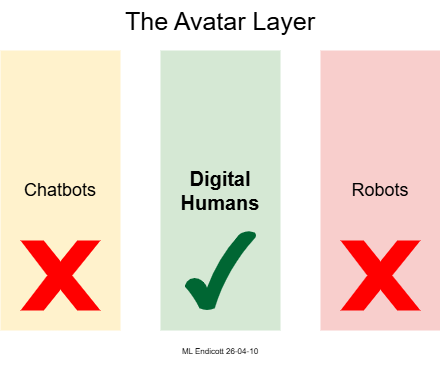
The subject is the avatar layer: virtual beings with a face and a voice. Chatbots and robots appear only where they carry one.
Start here · Travel and heritage — where the site began.
- Tourism Cases - digital humans in destination marketing, heritage interpretation, virtual guiding and visitor services, with the provincial tourism authorities, companies and conferences behind them
- The Provinces - digital-human timelines, province by province
The guide · Five domains, twenty-five chapters, read top to bottom.
- Strategic Foundations - Frames China’s digital humans within the state’s larger AI ambition, tracing the strategy, ideology, and soft-power design that treat synthetic figures as national infrastructure rather than novelty.
- Infrastructure, Regulation, and Standards - Presents the governed stack — compute, networks, technical standards, legal architecture, and talent pipelines — that makes large-scale, state-aligned deployment of digital humans possible.
- Industry, Platforms, and Application - Situates the digital human as a maturing commercial sector in which technology suppliers, state telecoms, and dominant content platforms industrialise, monetise, and normalise virtual personas.
- Culture, Society, and Public Life - Examines digital humans as cultural actors that shape tourism, commerce, fandom, and values, and the intimate bonds people increasingly form with virtual beings.
- Political, Symbolic, and Ethical Frontiers - Reads digital humans as the terrain where questions of governance, identity, and power are worked out, and against which China’s model is measured comparatively and ethically.
Go deeper · Browse by entity, subject or source.
- The Companies - more than 700 firms, venues and institutions in the digital-human value chain, each anchored to its official Chinese registration and summarised in both languages
- Subjects - the same companies arranged by what they contribute, from capture studios and generation engines to live commerce, state media anchors, and scenic-area guides
- Industry Reports - market studies, white papers, and rankings
- Academic Papers - the yearly best-of research base
The News - a daily briefing on digital-human news from Chinese and English sources, with a daily Weibo digest and video, plus feature articles and year-by-year timelines from 2019 on.
Resources - external tools and directories: Chinese LLMs, image search, trade shows, metaverse links, and open-source projects.
China Meta Guide is written and edited by Marcus L. Endicott. It carries no advertising and no sponsored content.
In focus :
China is backing two things at once in this decade, and digital humans stand where they meet. The first is artificial intelligence. The 15th Five-Year Plan (2026–2030), adopted by the National People’s Congress in March 2026, mentions it 52 times, against 11 in the plan before, and commits to fully carrying out the State Council’s “AI+” action, whose targets of August 2025 call for new-generation smart devices and AI agents to reach more than 70 percent take-up by 2027 and more than 90 percent by 2030. The second is travel. Foreign nationals made more than 82 million border crossings in 2025, up 26 percent on the year before, and 30 million of their entries were visa-free. In July 2026 the Ministry of Culture and Tourism’s plan for the same five years set targets of 190 million inbound tourist trips and more than US$150 billion in inbound spending by 2030, and called for smart guiding and interpretation at scenic areas and for better technology across trip planning, guiding and immersive experiences. A virtual guide, a museum docent, a destination’s digital ambassador: digital humans are among the most visible forms that technology takes, and on 3 April 2026 the Cyberspace Administration published draft measures for digital virtual human services, the first rules written for them alone, including a requirement that every digital human be clearly labelled as one.